Album
One band, one record, or just “Rehearsals 2026”. An album is also who is in it: people are invited to an album, never to a library.
iOS and Android
A shared song library for a band. Every idea, demo and mix lands in one place, in the order it happened, with the band's notes attached to the second they are about.
Free up to 30 minutes of audio, then 15 hours for 9,99 € a month. Adding members is always free.
 I play in Köömes, a band in Tallinn, and had this designed and produced for us.
Who made it
I play in Köömes, a band in Tallinn, and had this designed and produced for us.
Who made it

Songs happen over time
It starts as somebody humming into a phone. Then the whole band plays it and half of it changes. Then somebody adds a part at home, and months later there are studio mixdowns. Every tool a band has treats those as six unrelated files with confusing names. Takebase treats them as one song, in the order they happened.
Nothing is ever overwritten, so a year later you can play a finished song and still hear where it came from.
The three words
One band, one record, or just “Rehearsals 2026”. An album is also who is in it: people are invited to an album, never to a library.
The tune. It holds every attempt at it, newest on top, and it keeps them all.
One recording of that song. A new take goes on top of the last one and nothing is ever replaced.
That is the whole model. Nothing else to learn, and nothing hiding a folder inside a folder.
In practice
I play in Köömes. Before Takebase, an idea meant a voice memo mailed to everyone, and after that it was on each of us to keep hold of it. Nothing about that was organised, and none of it was anybody's fault.
A finished song still has the first rough phone recording at the bottom of its stack.
That is the part I did not expect. You can play a song forwards through its own history and hear where one guitar riff caught somebody else, what they put on top of it, and how the whole thing ended up somewhere the first version never suggested. It is also an honest record of how much work goes into three minutes of music.
We do still manage to add the same song twice. Somebody spots it in the comments and we sort it out, and that is about the worst thing that happens now. Nobody mails the band a list of timecodes any more.
Takebase is early, and we are still the ones testing it. We use it every week, every rehearsal turns up something else it should do, and there is a decent list of that ahead of us.
The loop
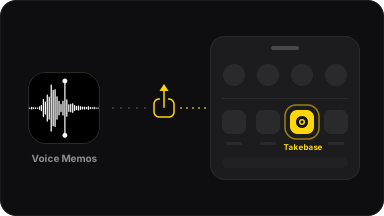
01
Record it in Takebase, to a metronome if you want one. Or use Voice Memos and the share sheet, if that is already your habit.
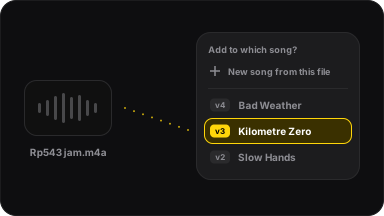
02
Pick the song it belongs to, or start a new one. It becomes that song's newest take.
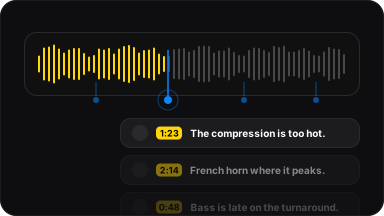
03
Tap the waveform where the problem is. The band reads your note at the second it happens, not in an email.
Takes
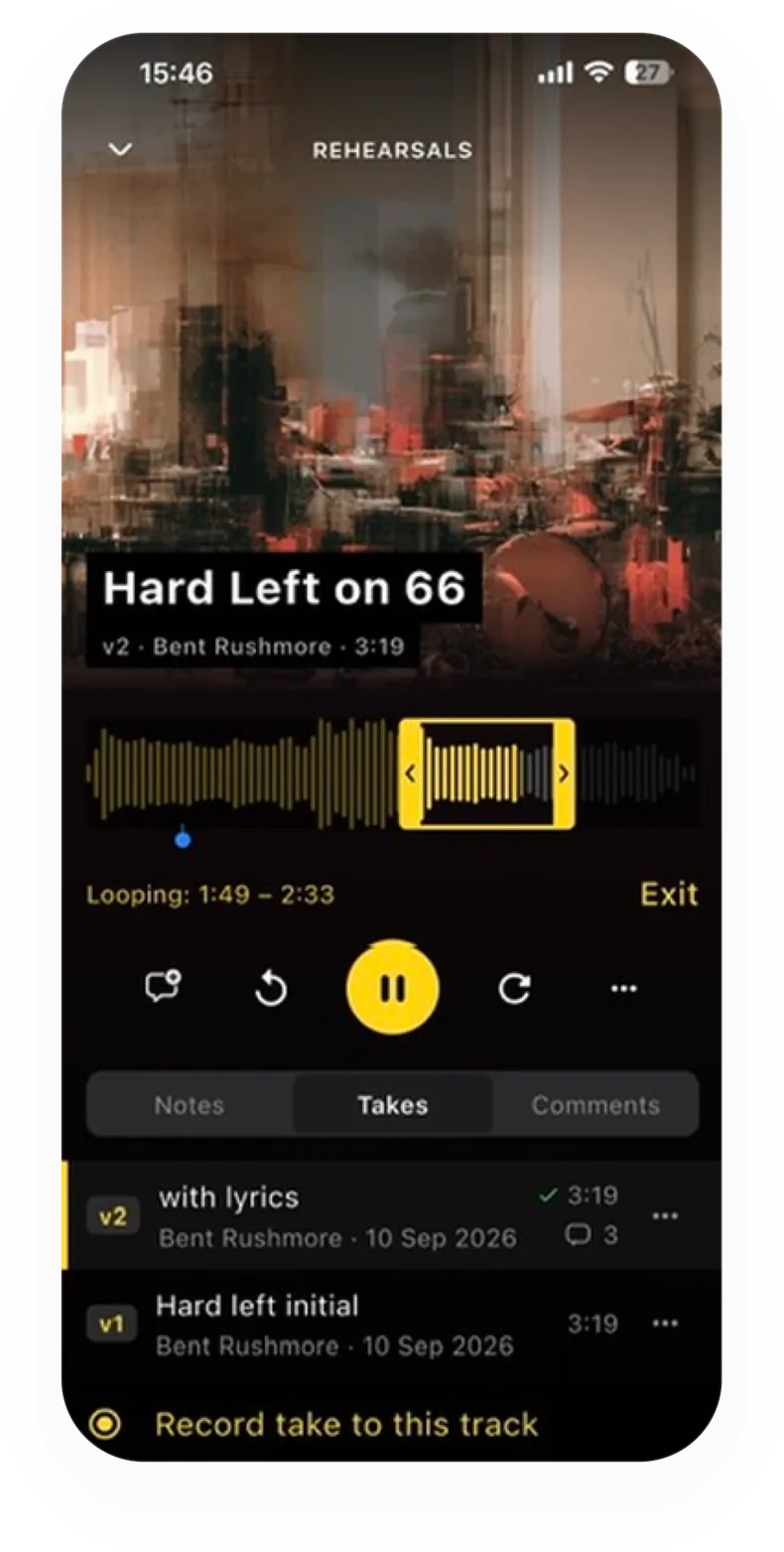
The phone demo from July is still there under the full-band take from last night. Takes stack newest first, and you choose which one the band hears.

Members
Sharing an album and inviting somebody to it are the same act. You send a link, and tapping it puts them in the album, able to listen, comment and add takes like anybody else. There are no roles to hand out, and no public page: a link plays nothing on the web.

Library
Everyone in the band opens the same library and hears the same thing. Albums you own and albums shared with you sit side by side, and the player follows you around the app.

What an album is for
Songs in an album can be dragged into whatever order you like, so an album is not only where the takes live. It is the running order, and you can argue about it while every song in it is still a phone recording.
The order is the band's: drag it once and everybody sees it that way. Keep one album for ideas and another for the record you are actually making.
One album per band or per project, and you can be in as many as you like. My own ideas are in one, Köömes is in another, and something with two other people is in a third.
Same app and same loop either way, and nobody ever sees an album they were not invited to.
Everything it does
You pay for the audio you store, and never for a person. Nothing on this list is behind the subscription, so a band of four can use every one of these on the free plan and one of you pays only when the uploads get past the allowance.
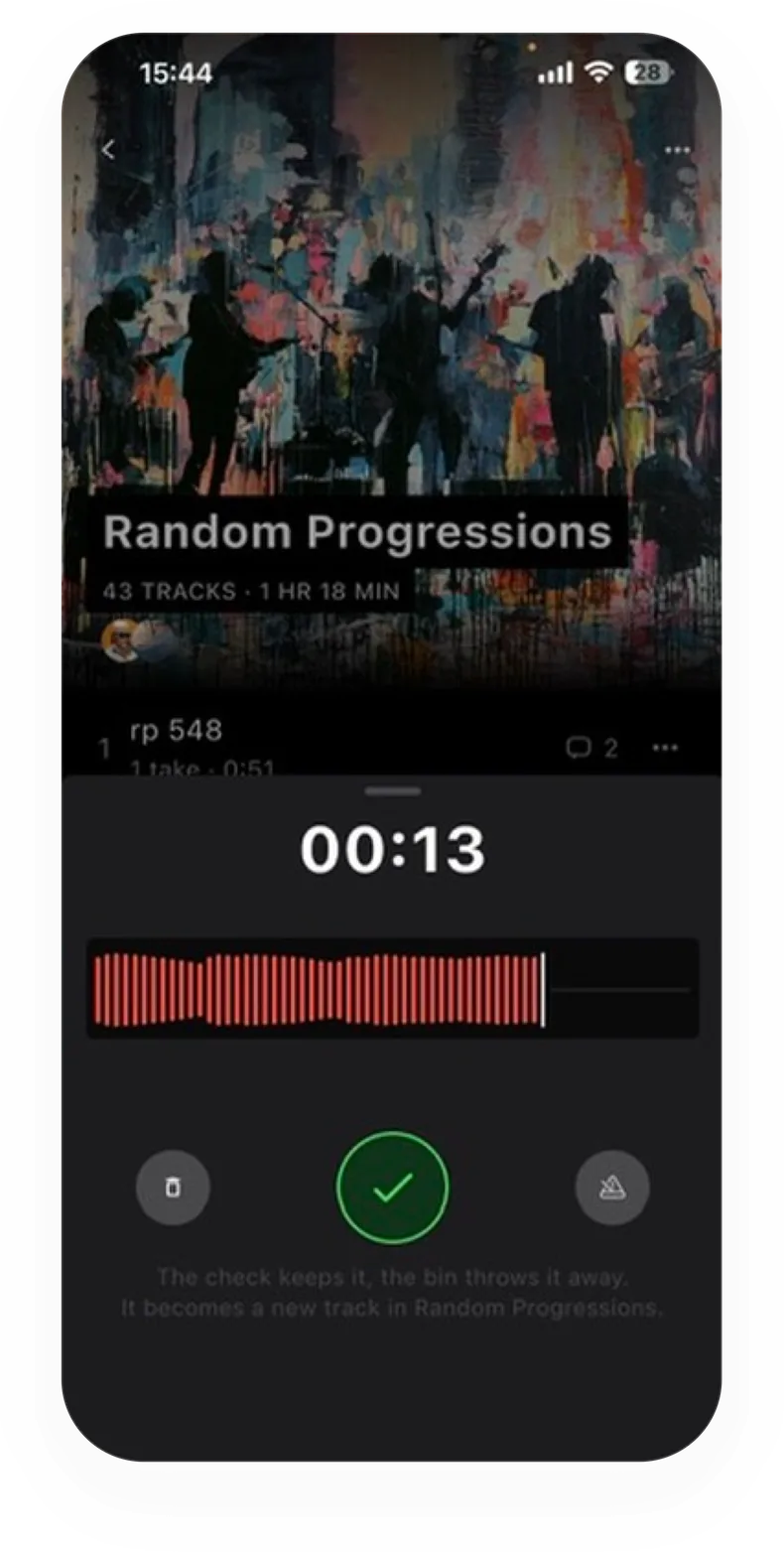
The app has its own recorder. No second app, no share sheet, and the take lands on the song you started from.
The iOS share sheet, the Android share menu, or the file picker. m4a, mp3, wav and aiff.
Record over a take, hear both together before you decide anything, then keep it as the newest take or bin it and go straight round again.
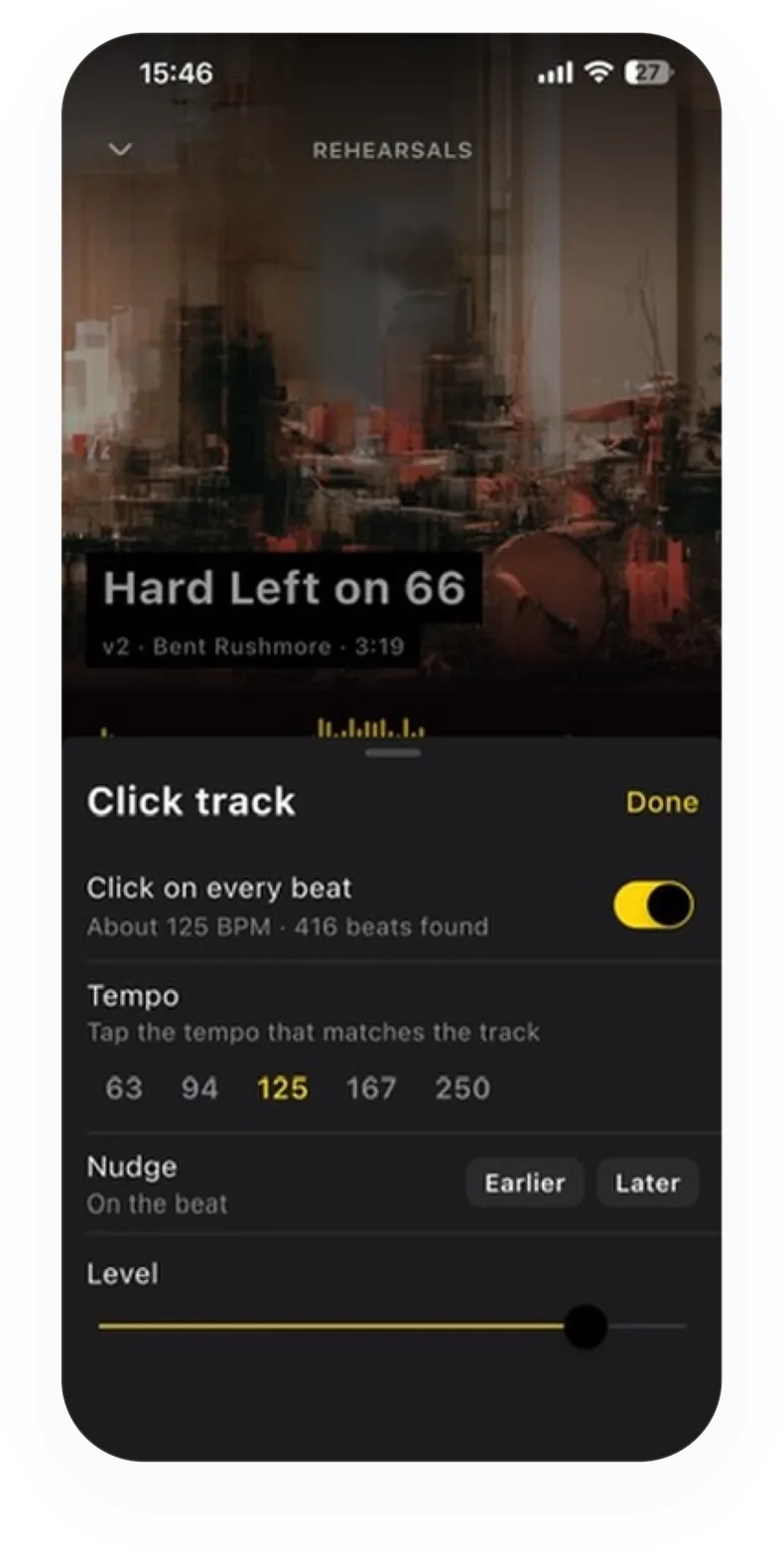
Not a BPM you type. Every beat is found in the recording itself, so a take that drifts is followed rather than fought. Halve it, double it, nudge it.
Drag the part nobody can play yet and play it round until they can.
Tap the waveform where the problem is. Bold, headings, lists and links, a full-screen editor, and an hour to fix a typo.
One sheet of Notes the whole band edits, read on the player while the take is playing.
A new take goes on top of the last one and nothing is ever replaced. Switch between them mid-listen.
Say a track's name with the phone locked and it plays. CarPlay, and the band's recordings in the phone's own search.
A share link is a web page for a single take. No app, no account, and it stops working a day later.
The library is a grid of covers, and a colour you put on a track is the band's, not just yours.
Audio in the European Union, no feed, no profiles, and never training data.
Private by default
Unreleased music is the entire content of this app, so here is exactly what happens to it.
Getting a file in
The iOS share sheet, the Android share menu, or the file picker inside the app. Whichever door it comes through, Takebase asks one question: which song does this belong to?
Takes in
m4a, mp3, wav, aiff. Not flac and not ogg, and the app says which by name rather than failing at you.
What your phone does with it
One decode pass on the device: an AAC file at 192 kbps, at your file's own sample rate, and the waveform drawn from the same pass. An m4a is uploaded untouched.
So what this is
Reference audio for a band to work from, not an archive. Your master never leaves your machine, and it shouldn't - only the converted copy is uploaded.
Getting a file back out
Not yet. Download is built and deliberately switched off while the app is new.
Where the audio lives
Cloudflare R2, in the European Union.
Where everything else lives
Google Firestore in Finland: albums, songs, takes, comments, memberships. Backups are kept for a week and then expire.
Playing it
A signed address that stops working after an hour. Nothing in the bucket is public and no web page anywhere plays your audio.
Invites
A link is an invitation to an album and it stops working 24 hours after it is made. Remove a member and their access ends immediately.
What is public
Nothing. No feed, no discovery, no profiles to browse, no way to find a band that did not invite you.
AI
None of it, ever. Your recordings are not training data and never will be, and the only thing that ever decodes your audio is your own phone.
Deleting
Gone from the app for everyone the second you confirm, the minutes back on your allowance the same second, no undo for anybody, and the file itself erased from storage within 48 hours.
Over your allowance
Uploads stop, and playback stops with them, until you delete something or subscribe. Nothing is ever deleted for you.
Abandoned free accounts
Warned by email after 150 days of silence, emptied at 180. Free accounts only, it is in the Terms, and opening the app resets the clock.
Runs on
iPhone and Android. No desktop app and no browser version.
Looks like
Dark, always. It is for a rehearsal room at one in the morning.

Bent Rushmore · Tallinn
Who made it
Everything on this page got settled by four people arguing about a take, not by a roadmap.
I write and release records out of Tallinn. Four of them so far. I spend the rest of my time around apps, which is the only reason this ended up a product instead of a complaint.
Köömes is where all of this came from, and the section above is our actual week. What made it a product rather than a complaint is what it cost to fix: the version history and the sharing controls we reached for every week sat behind a tier priced for a studio, not for four people passing voice memos around.
So Takebase does that week and stops there. Musicians have been testing it since the first build that ran on a phone, and most of what is on this page came out of that. So did the deletions: sessions, folders, a tab bar, an A/B compare. Specified, some of them built, all cut once it was clear nobody reached for them.
Pricing
The meter counts minutes of stored audio rather than gigabytes. 30 minutes is about ten three-minute takes, which is enough to put a few real rehearsals through the app before anybody pays; 15 hours is about three hundred. It counts the albums you own, so an album somebody shares with you costs you nothing, and the takes your bandmates add to your album are charged to you. A band where one person does the uploading needs one Pro between them.
Free
0 €
30 minutes of stored audio, per account
Takebase ProSave 42% yearly
9,99 €/ month
or 69,99 € a year
15 hours of stored audio, thirty times the free allowance.
Pro starts with a free month at the moment, and the App Store confirms you are eligible before it charges anything. Billed through the App Store or Google Play, at whatever your own storefront charges, and Takebase never sees a card number.
Questions
A shared song library for a band, on iPhone and Android. Every recording of a song stacks on that song in the order it happened, the band's comments are pinned to the second they are about, and nothing is ever replaced or made public.
Four doors. Record it straight into Takebase, to a metronome if you want one. Or share it in from Voice Memos, from the Android share menu, or out of the file picker, if a recorder you already know is the one you would rather use. Whichever way it arrives, Takebase asks one question: which song does this belong to? It becomes that song's newest take. It takes m4a, mp3, wav and aiff.
That is the thing it is built around. Tap the waveform where the problem is and the note is pinned to that second, so the band reads the snare is late at the snare rather than in an email three days later.
It goes further than sending a take out for comments, and it charges on a different basis.
Takebase carries the rehearsal, not just the review of it: record straight into the app, loop the eight bars nobody can play yet, overdub your part over a take and keep it as the next one, get a click that follows a drifting recording instead of a BPM you typed, and keep the song's words on the song. All of it, in one list.
Then the money, which is the sharper difference. You pay for what you store, and never per person. Nothing here is behind the plan: there is no feature a subscription unlocks, so everybody who listens, comments, writes the words and switches takes is free for ever, with the whole app. Only the account whose uploads fill its allowance ever needs Pro. A band where one person does the uploading needs one subscription between four people, not four.
Free up to 30 minutes of stored audio, with every feature in the app and as many members as the band has. Takebase Pro is 9,99 € a month or 69,99 € a year for 15 hours, billed through the App Store or Google Play. Adding members is always free. The two plans, side by side.
No, and it is not a trial: one of you might, and the other three are free for ever with every feature. The allowance is stored audio on your own account, so an album somebody shares with you costs you nothing and spends their minutes, not yours. Listening, commenting, writing the Notes and adding a take to somebody else's album never fill an allowance you have. In most bands one person does the uploading, and that is the one subscription.
iPhone on iOS 15 and later, and Android. The library, the recorder, the takes, the comments and the Notes are on both. The studio tools are on iPhone first: overdub, the click track, the loop and the Siri and CarPlay work are iOS today, and where a feature is missing the control is simply absent rather than dangled at you. There is no desktop app and no browser version of the app itself, deliberately: it is for a rehearsal room, not a desk. A share link does open in any browser.
Two kinds of link do that. An invite link puts somebody in the album, where they listen, comment and add takes like anybody else. A share link is a web page for one take, and it needs no app and no account. Both stop working a day after they are made, and the audio behind them plays from a signed address that dies within the hour.
There is nothing public to be found: no feed, no discovery, no profiles, and no way to reach a band that did not invite you. Audio sits in Cloudflare R2 in the European Union and everything else in Google Firestore in Finland. Your recordings are not training data and never will be, and the only thing that ever decodes your audio is your own phone. The whole of it, in plain words.
Delete a take and it is gone from the app for everyone the second you confirm, the minutes are back on your allowance the same second, and the file is erased from storage within 48 hours. There is no undo, for anybody. An account and everything in it goes the same way, from inside the app or by email: how to delete your account.
iOS and Android. Free up to 30 minutes of audio per account, and inviting people never costs anything.


Comments
Notes land on the second they are about.
The compression is too hot. That note fights the chord. Somebody wants a French horn where the song peaks. None of that is an email with hand-typed timecodes any more: you tap the waveform at 2:14 and the note sits there, where it is about.